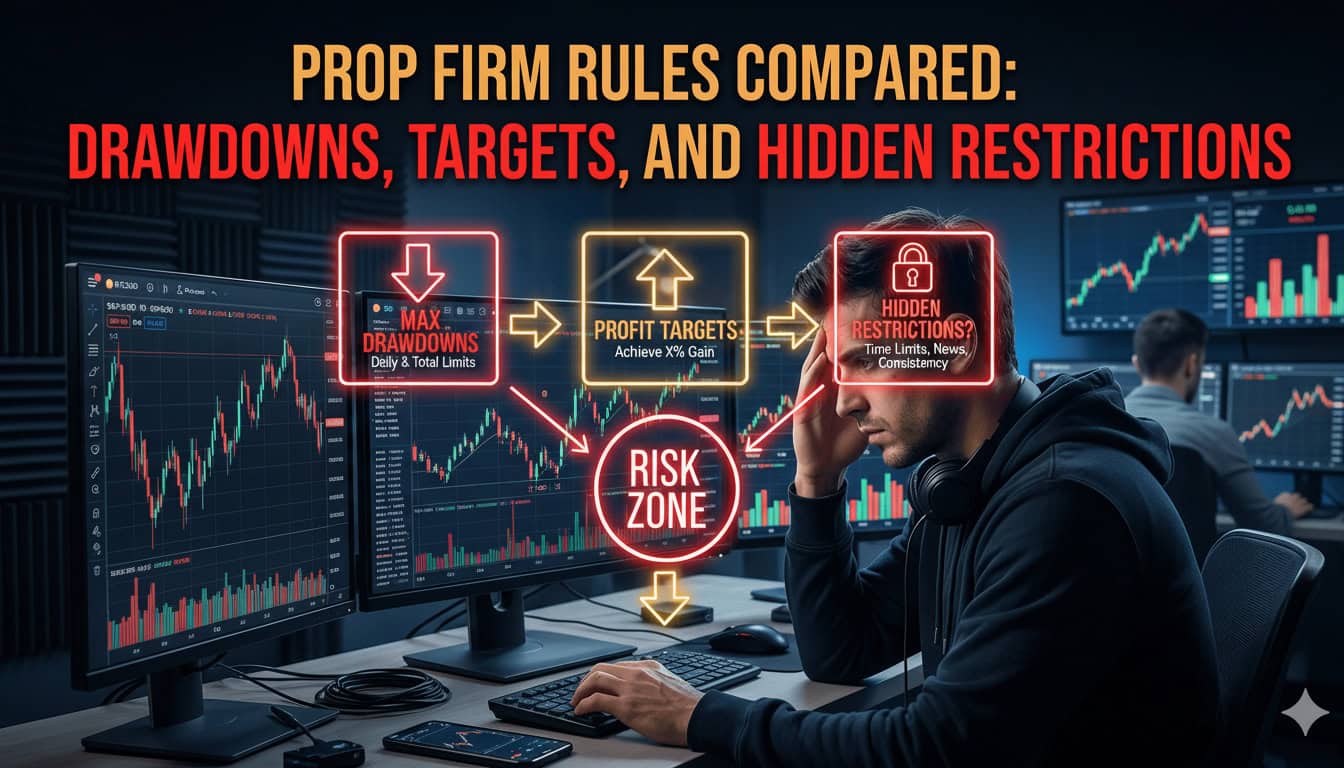
Every prop firm has a rule that can end your account. Most traders focus on profit targets and drawdown limits because those are the big numbers on the website. But the rules that actually kill accounts are buried in the fine print: consistency requirements, contract scaling, inactivity policies, and session restrictions you didn’t know existed.
I pulled the full rulebooks for eight major futures prop firms and laid everything out in one place. Some of what I found will save you from picking the wrong firm.
Evaluation rules compared
| Firm | Profit Target (50K) | Drawdown (50K) | Drawdown Type | Daily Loss Limit | Time Limit | Min Days |
|---|---|---|---|---|---|---|
| Apex | $3,000 | $2,000 | Intraday trailing / EOD option | None / $1,000 (EOD) | 30 days | None |
| Topstep | $3,000 | $2,000 | EOD trailing | $1,000 | Unlimited | None |
| MFF | $3,000 | $2,000 | EOD trailing (eval) | None | Unlimited | 2 |
| Bulenox | $3,000 | $2,000 | Trailing | Varies | Unlimited | None |
| TradeDay | $3,000 | $2,000 | Trailing | Varies | Unlimited | None |
| TPT | $3,000 | $2,000 | Trailing | None (removed 2025) | Unlimited | None |
| Alpha Futures | $3,000 | $2,000 | Trailing | Varies by plan | Unlimited | None |
| TickTick | $3,000 | $2,000 | Trailing | Varies | Unlimited | None |
At the evaluation level, most firms look similar. The standard is $3,000 profit target with $2,000 drawdown on a 50K account. The differences show up in drawdown type, daily loss limits, and time constraints.
Apex is the only firm with a hard 30-day deadline. Every other major firm gives you unlimited time. MFF requires a minimum of 2 trading days (so you can pass in 2 days if you split the target exactly). Apex has no minimum and allows passing in 1 day.
The daily loss limit is a bigger deal than it sounds. MFF and Take Profit Trader have no daily loss limit at all — a bad morning doesn’t automatically end your eval. Apex’s intraday option also has none. Topstep enforces a $1,000 daily limit on 50K accounts, meaning a single session loss of $1,001 kills your evaluation regardless of your total profit.
The hidden rules that matter more
Consistency rules
This is where firms restrict your ability to withdraw money after you’ve earned it.
| Firm | Consistency Rule (Funded) | Impact |
|---|---|---|
| TickTick Trader | 30% | Strictest. One big day = many small days needed to dilute |
| Bulenox | 40% | Restrictive. Need 1.5x the big day across other sessions |
| Alpha Futures (Std) | 40% | Same as Bulenox |
| Topstep (Consistency path) | 40% | Only on Consistency payout path |
| Apex | 50% | Most manageable. Best day can’t exceed half of total |
| MFF Core | 40% | Core plan only |
| MFF Rapid / Pro | None | No consistency rule at all |
| Take Profit Trader | None | Removed entirely |
| Alpha Futures (Advanced) | None | Advanced plan only |
The consistency rule is the single biggest payout blocker in the industry. A trader on TickTick who makes $3,000 on Monday and $500 on Tuesday-Friday has $3,000/$5,000 = 60% from one day. They need to generate another $5,000+ across separate days before that Monday drops below 30%. Meanwhile the money sits there, exposed to drawdown risk, while you trade just to meet an arbitrary ratio.
If consistency rules frustrate you, MFF Rapid, Take Profit Trader, or Alpha Futures Advanced are the only funded options without them.
Contract restrictions and scaling
What you can trade in evaluation versus what you can trade once funded:
Apex (50K): 6 contracts in eval → starts at 2 in PA, maxes at 4. That’s a 67% reduction at the start. Your evaluation strategy probably used more contracts than your funded account allows.
Topstep (50K): 5 contracts in eval → scaling plan in XFA based on balance. Position sizing is restricted until your balance grows.
MFF Rapid: Micro-contract scaling in funded stage. Start small, scale up with balance.
MFF Pro: No scaling. Full position sizes from day one. This is the only major plan that doesn’t reduce your contracts after passing.
Take Profit Trader: Buffer-based. Once above the buffer, trade normally.
The Apex contract reduction is the most aggressive. A trader who developed a 4-contract ES strategy during eval has to start their PA with 2 contracts and can only reach 4 after building $3,000+ in profit. The strategy they practiced on doesn’t match the account they receive.
Session and overnight restrictions
| Firm | Session Close Deadline | Overnight Holding | Weekend Holding |
|---|---|---|---|
| Apex | None specified | Not allowed (PA) | Not allowed |
| Topstep | 3:10 PM CT | Not allowed | Not allowed |
| MFF | None specified | Allowed (flatten by Friday) | Not allowed |
| Take Profit Trader | None specified | Varies by account | Not allowed |
Topstep’s 3:10 PM CT close deadline is unique and restrictive. If you trade the afternoon session or want to hold into the close, you can’t on Topstep. This eliminates entire categories of trading strategies.
MFF is the most flexible — overnight holds are allowed as long as you flatten by Friday close. If you trade European session overlap or hold positions for multiple hours, MFF gives you the most room.
Inactivity policies
Apex: 2 trading days with $50+ profit per rolling 30 days, or account goes dormant at 15 days and closes at 30 days. Permanently. No reinstatement.
Topstep XFA: 30 days of inactivity = closure.
Topstep LFA: 90 days of inactivity = permanent closure.
TickTick Trader: 7 days without a trade = account terminated. The strictest inactivity policy in the industry. Going on a one-week vacation without telling the firm kills your account.
MFF: Varies by plan but generally more lenient.
These rules mean you can’t “park” a funded account. If you need to take time off for any reason — vacation, medical, personal — check your firm’s inactivity policy first. TickTick’s 7-day rule is genuinely dangerous for anyone who doesn’t trade every week.
Payout caps and account lifespan
| Firm | Max Payouts | Account Lifespan | Max Extraction (50K) |
|---|---|---|---|
| Apex | 6 | Closes after 6th payout | ~$14,500 |
| Topstep | Unlimited | Open until breached or inactive | Unlimited |
| MFF Rapid | Unlimited | Open until breached | Unlimited (sim) |
| MFF Pro | Until $100K cap | $100K cumulative cap | $100K total |
| Bulenox | Unlimited (after 3) | Open | Unlimited after 3 payouts |
| Take Profit Trader | Unlimited | Open | Unlimited |
Apex’s 6-payout cap is the most restrictive account lifespan in the industry. No other major firm forces account closure after a set number of withdrawals. For a 50K account, you can extract $14,500 maximum before needing a new evaluation. This turns prop trading into a cycle: pass, extract, repeat.
The firms with unlimited payout structures (Topstep, MFF Rapid, TPT, Bulenox after third payout) allow you to keep a funded account running indefinitely as long as you stay within the rules. The long-term earning potential is significantly higher.
News trading restrictions
Allowed everywhere: MFF (evaluation stage), Take Profit Trader
Restricted: MFF Rapid (not allowed in sim funded stage), some Apex PA limitations
Effectively restricted: Topstep (3:10 PM close deadline limits major news events)
If you trade CPI, FOMC, NFP, or other high-impact news events, check the funded account rules specifically. Some firms allow news trading in evaluation but restrict it in funded stage. Getting used to a strategy during eval that you can’t use once funded is a common and expensive mistake.
The rules that actually kill accounts
In order of how many accounts they terminate:
- Drawdown breach (87% of failures). The type of drawdown matters more than the amount. Intraday trailing kills significantly more accounts than EOD trailing at the same dollar limit.
- Daily loss limit violations. One bad session hits the daily limit and the evaluation or account ends immediately. Firms without daily loss limits (MFF, Apex intraday, TPT) eliminate this risk entirely.
- Consistency rule blocking payouts. Traders earn money but can’t withdraw it, keep trading to meet the ratio, and eventually breach the drawdown while trying to dilute a big winning day. The consistency rule indirectly causes drawdown breaches.
- Contract/scaling mismatch. Strategy works with 6 contracts but funded account only allows 2. Trader forces the strategy with fewer contracts, doesn’t get the same results, takes more risk to compensate, and breaches.
- Inactivity termination. Life happens. Trader takes a break. Account closes permanently.
Which firm has the fairest rules?
Based on the full comparison: MyFundedFutures Pro has the fairest combination. EOD trailing drawdown, no daily loss limit, no consistency rule in funded stage, no contract scaling restrictions, overnight holding allowed. The trade-offs are an 80/20 split and a $100K lifetime cap, but the rules themselves are the most trader-friendly I’ve found.
Take Profit Trader is second — no consistency rule, no payout limits, unlimited withdrawal frequency. The 80/20 PRO split and the $5K PRO+ lock-in are the downsides.
The firms with the most restrictive rules are TickTick Trader (30% consistency + 7-day inactivity), Apex (intraday trailing + contract reduction + 6-payout cap), and Topstep (3:10 PM close + TopstepX only + daily loss limit).
Read the rules before you buy the evaluation. The profit target is the easiest part. The rules are what determine whether you keep the money after you’ve earned it.
Looking to try Apex Trader Funding? Use code DLAB for up to 90% off evaluations. Start here →
Affiliate link. We may earn a commission at no extra cost to you.